

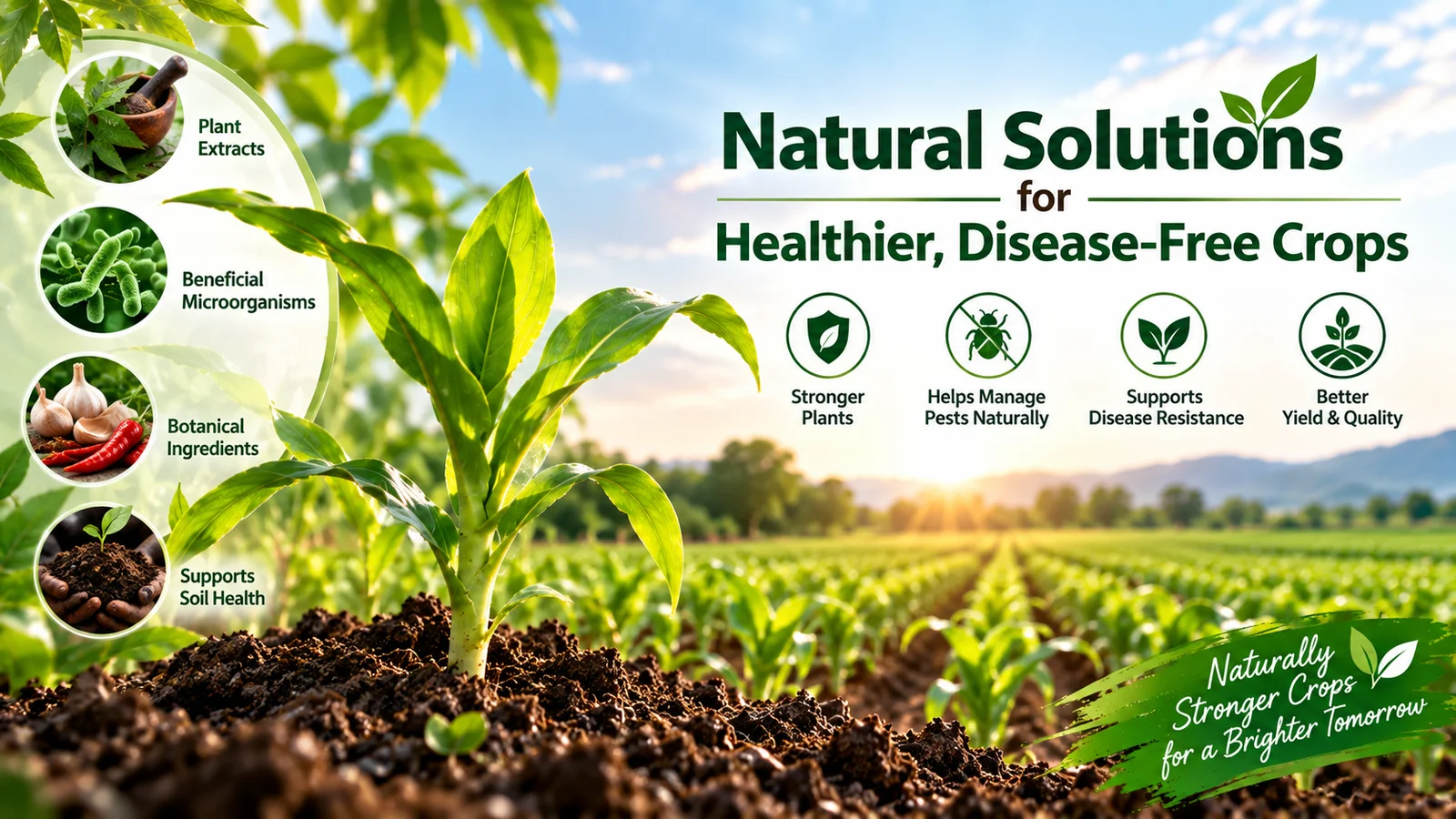
Natural Solutions for Healthier, Disease-Free Crops
Healthy crops are the foundation of successful agriculture. However, diseases, insects, unfavorable weather, poor soil health, and nutrient deficiencies can significantly affect crop growth and productivity. While conventional chemical inputs can play an important role in crop protection, farmers are increasingly exploring natural and biological approaches that support plant health while promoting sustainable farming.
Natural crop protection focuses not only on controlling problems after they appear but also on creating conditions in which plants can grow stronger and tolerate stress more effectively.
Why Plant Health Matters
A healthy plant has a better ability to develop strong roots, produce healthy foliage, flower properly, and produce quality fruits or grains. On the other hand, stressed plants can become more vulnerable to diseases and pests.
Factors such as:
- Poor soil fertility
- Nutrient deficiencies
- Excessive moisture or drought
- Weak root development
- Unbalanced fertilization
- Pest infestations
- Fungal and bacterial diseases
can all contribute to reduced crop performance.
This is why crop protection should be considered as part of a complete plant-health management strategy.
1. Build Healthy Soil
Healthy soil provides the foundation for healthy crops. Organic matter helps improve soil structure, moisture retention, aeration, and nutrient cycling.
Organic manures and compost-based inputs can contribute to soil fertility while supporting beneficial biological activity. Vermicompost, for example, can enrich soil with nutrients and beneficial microorganisms while improving soil structure and water-holding capacity.
Regular addition of suitable organic matter can therefore help create a more favorable environment for root development.
2. Strengthen the Root System
Strong roots allow plants to absorb water and nutrients more effectively. They also help plants establish themselves during early growth and cope with environmental stress.
Mycorrhizal biofertilizers can support root development by forming beneficial associations with plant roots. These associations can help plants access nutrients and water from the surrounding soil.
A stronger root system can contribute to better plant establishment and overall crop performance.
3. Use Beneficial Microorganisms
The soil contains a complex community of microorganisms. Some microorganisms can support plant growth and contribute to a healthier soil environment.
Biological products containing beneficial microorganisms can be incorporated into crop management programs where appropriate. These approaches can complement good soil management and help maintain biological balance around the plant root zone.
4. Manage Plant-Sucking Insects Naturally
Pests such as aphids, thrips, spiders, and whiteflies can damage plants by feeding on plant tissues and reducing plant vigor.
Plant-extract-based crop protectors offer one natural approach to pest management. For example, products such as Fantox are formulated from plant extracts and are intended for use against plant-sucking insects.
Natural pest-management products can be incorporated into an integrated crop protection program alongside monitoring, sanitation, and other appropriate agricultural practices.
5. Support Plants with Balanced Nutrition
Disease and pest management should not be separated from plant nutrition. Plants require a balanced supply of macro- and micronutrients for normal growth and development.
Nutrients such as zinc, iron, boron, manganese, copper, and molybdenum support important physiological processes. When plants experience nutrient deficiencies, growth and development can be affected.
Therefore, soil testing and balanced fertilization are important steps toward maintaining healthy crops.
6. Improve Soil Moisture Management
Both excessive water and drought can place plants under stress. Poor drainage can encourage unfavorable soil conditions, while insufficient moisture can restrict nutrient uptake and root development.
Improving soil structure and water-holding capacity through appropriate organic matter management can help maintain more favorable moisture conditions.
Good irrigation practices should also be adjusted according to the crop, soil type, weather, and growth stage.
7. Reduce Dependence on Unnecessary Chemicals
Natural crop protection does not necessarily mean eliminating every conventional agricultural input. Instead, the objective is to use inputs responsibly and according to actual crop requirements.
Farmers can adopt an Integrated Pest Management (IPM) approach that combines:
- Regular crop monitoring
- Good field sanitation
- Resistant or suitable crop varieties
- Beneficial organisms
- Biological crop-protection products
- Appropriate cultural practices
- Chemical treatments when necessary and recommended
This approach can help avoid unnecessary applications while maintaining effective crop protection.
Natural Crop Protection Is a Complete Approach
A successful natural crop-health program is not based on one product or one practice. It combines several aspects of farming:
Healthy soil → Strong roots → Balanced nutrition → Better plant growth → Improved stress tolerance → Effective pest and disease management
When these elements work together, farmers can create a more supportive growing environment for their crops.
Benefits of Natural Crop Management
Adopting natural and biological approaches can provide several potential advantages:
- Supports healthier soil
- Encourages beneficial microbial activity
- Promotes stronger root development
- Supports balanced plant nutrition
- Helps manage certain pests and crop-health problems
- Can reduce unnecessary dependence on synthetic inputs
- Supports sustainable agricultural practices
- Contributes to long-term soil productivity
Conclusion
Producing healthier, disease-free crops begins long before visible disease symptoms appear. Healthy soil, strong roots, balanced nutrition, proper moisture management, regular monitoring, and responsible crop protection all contribute to stronger plants.
Natural and biological solutions can become an important part of this approach. When combined with good agricultural practices and informed decision-making, they can help farmers work toward healthier crops, better soil, and more sustainable production.
Healthier soil. Stronger plants. Smarter crop protection. A more sustainable future for farming.